


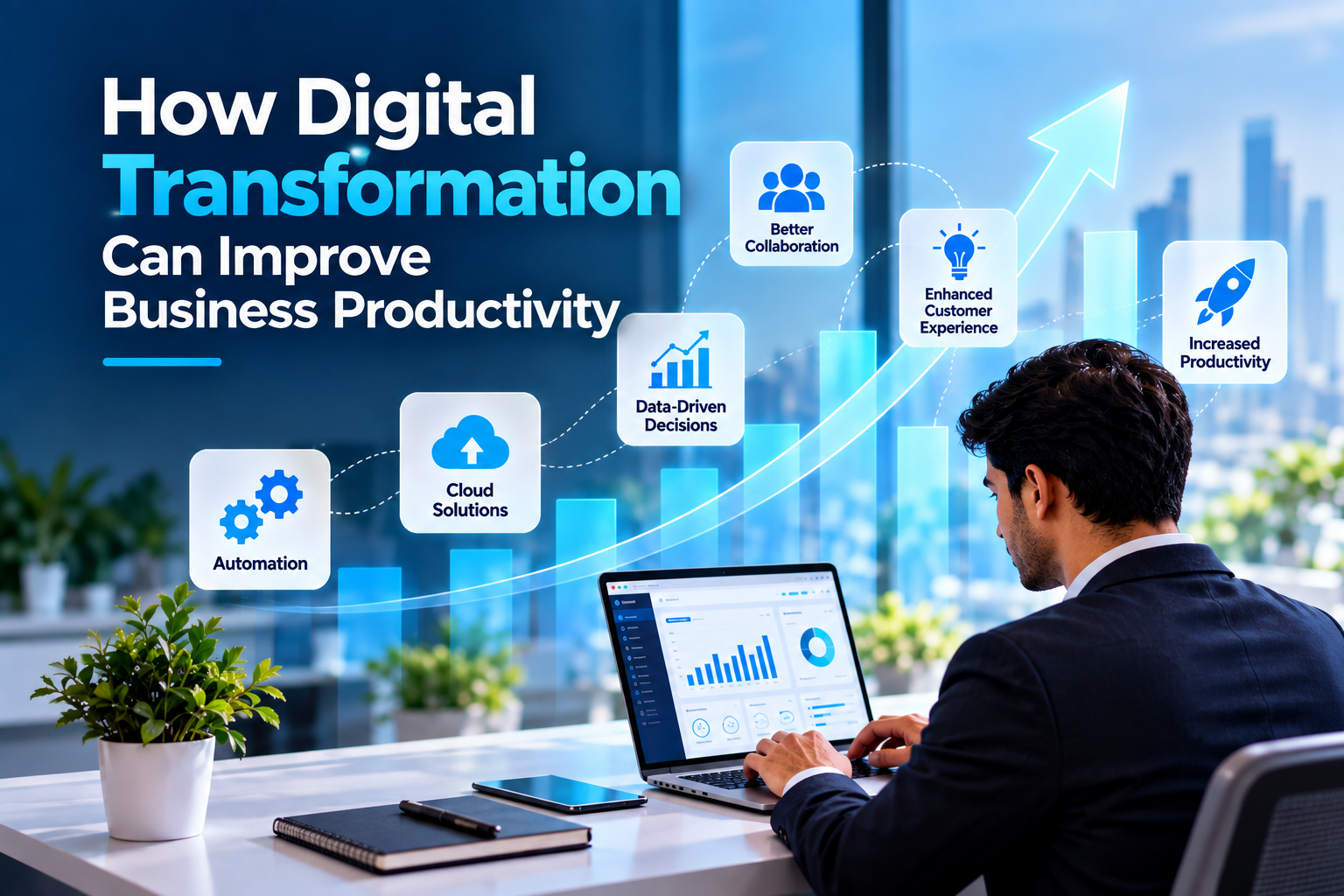
Businesses today operate in an environment where speed, efficiency, customer expectations, and technology are constantly evolving. Traditional processes that rely heavily on manual work can make it difficult for organizations to respond quickly to these changes. Digital transformation helps businesses modernize their operations by integrating technology into everyday processes. From cloud computing and automation to artificial intelligence and data analytics, digital tools can help organizations simplify workflows, improve collaboration, and make better use of their resources. When implemented with clear business objectives, digital transformation can become an important driver of productivity and sustainable business growth. What Is Digital Transformation? Digital transformation is the process of integrating modern digital technologies into different areas of a business to improve how it operates and delivers value to customers. It is not simply about purchasing new software. Successful transformation often involves reviewing existing processes, identifying inefficiencies, connecting business systems, training employees, and introducing technology where it can create measurable improvements. For example, a company might replace manual spreadsheets with a centralized management system, move files to secure cloud storage, automate customer follow-ups, or introduce analytics dashboards for management.
****
1. Automating Repetitive Business Processes
Automation is one of the most practical ways digital transformation can improve productivity. Employees often spend significant time performing repetitive tasks such as entering data, generating reports, sending routine emails, processing invoices, updating customer information, and scheduling appointments. Automation tools can handle many of these activities with limited manual intervention. This allows employees to focus more attention on customer relationships, problem-solving, strategy, and other higher-value work. Automation can also create more consistent processes and reduce errors caused by repetitive manual data entry.
2. Improving Communication and Collaboration
Effective communication is essential for productive teams. However, information can become fragmented when employees depend on separate email conversations, spreadsheets, documents, and messaging platforms. Digital collaboration tools can bring communication, documents, tasks, and project information into shared environments. Cloud computing allows businesses to access scalable technology resources and applications over the internet. Businesses can learn more about cloud computing through the [National Institute of Standards and Technology (NIST) Cloud Computing resources.](https://www.nist.gov/publications/nist-cloud-computing-reference-architecture?utm_source=chatgpt.com...) Cloud-based document systems, project management platforms, video conferencing, and team communication tools allow employees to access relevant information and collaborate regardless of their physical location. This can be particularly valuable for businesses operating with remote or hybrid teams.
3. Making Better Decisions With Data
Businesses generate data from sales, websites, customer interactions, marketing campaigns, financial systems, and internal operations. Without the right tools, much of this information may remain unused. Digital transformation enables businesses to organize and analyze their data through dashboards, analytics platforms, and reporting systems. Managers can monitor key performance indicators, identify patterns, compare results, and access important information more quickly. Data-driven insights can support better planning and help businesses identify areas where operations could be improved.
4. Increasing Productivity With Cloud Technology
Cloud computing has become an important part of modern digital transformation strategies. Instead of relying entirely on applications and files stored on individual computers or local servers, businesses can use cloud platforms to access systems and information through secure internet connections. Cloud solutions can support file sharing, application hosting, backups, collaboration, and remote access. They can also make it easier for businesses to adjust technology resources as their requirements change, without necessarily maintaining all infrastructure internally.
5. Enhancing Customer Experience
Digital transformation is not limited to internal productivity. It can also improve how customers interact with a business. Modern websites, mobile applications, online booking platforms, customer portals, CRM systems, automated notifications, and AI-powered support tools can make services easier for customers to access. For example, instead of requiring customers to call a business to check an appointment, a digital system could allow them to book or manage appointments online. Improving these customer journeys can also reduce administrative work for employees.
6. Connecting Different Business Systems
Disconnected software can create unnecessary work. For example, customer information collected through a website may need to be manually copied into a CRM, accounting system, or internal spreadsheet. Digital transformation can use APIs and system integrations to connect these applications. A website enquiry could automatically create a CRM record, notify the sales team, assign the lead to an employee, and trigger an acknowledgement email. Integrated workflows reduce repeated data entry and help information move between departments more efficiently.
7. Using AI to Support Employee Productivity
Artificial intelligence is becoming another component of digital transformation. AI-powered tools can assist employees with activities such as summarizing documents, searching internal information, preparing reports, analyzing data, drafting communications, and responding to common customer questions. AI can also support automation by processing information that would traditionally require more manual review. However, businesses should establish appropriate human oversight, privacy controls, and review processes when implementing AI systems.
8. Strengthening IT Operations and Security
As organizations become more digital, reliable IT infrastructure and cybersecurity become increasingly important. Modern IT management tools can help organizations monitor applications, manage devices, control user access, maintain backups, and identify unusual system activity. Businesses can also introduce security measures such as multi-factor authentication, role-based access controls, encryption, software updates, and centralized monitoring. A digital transformation strategy should therefore consider cybersecurity alongside productivity and convenience.
9. Supporting Remote and Hybrid Work
The modern workforce increasingly depends on the ability to access information and collaborate from different locations. Cloud applications, secure remote access, video conferencing, digital document management, and project management platforms can help employees work effectively outside a traditional office environment. Centralized digital systems also reduce dependence on information stored on individual devices, helping teams access the resources they need wherever authorized access is available.
10. Creating Scalable Business Processes
Manual processes may work when a company has a small number of customers, employees, or transactions. As the organization grows, those same processes can become difficult to manage. Digital transformation helps businesses create processes that can support increasing workloads. Automated workflows, cloud infrastructure, CRM platforms, ERP systems, and integrated applications can help organizations manage growth while reducing the need to manually increase every administrative process. Key Benefits of Digital Transformation A successful digital transformation initiative can provide several operational benefits, including: Reduced repetitive manual work Faster access to business information Improved team collaboration More efficient workflows Better use of business data Improved customer experiences Greater flexibility for remote work Easier integration between business systems More scalable operations Improved visibility into business performance The specific results will depend on the technologies selected, existing processes, employee adoption, data quality, and implementation strategy. How to Start Digital Transformation in Your Business Businesses do not necessarily need to transform every process at once. A practical approach is to identify areas where employees spend significant time on repetitive or inefficient activities. Start by reviewing existing workflows and defining the business problem you want to solve. Then evaluate suitable technologies, determine security and integration requirements, and establish measurable objectives. Organizations can initially implement digital transformation in one department or process, evaluate the results, and gradually expand successful solutions to other areas. Employee training is equally important. Technology creates greater value when employees understand how and why new systems should be used. The Future of Digital Transformation Digital transformation will continue to evolve as technologies such as artificial intelligence, automation, cloud computing, data analytics, and connected applications become more capable. The objective, however, should not be to adopt every new technology available. Businesses should focus on technologies that solve genuine operational problems, improve customer experiences, reduce unnecessary work, or provide better information for decision-making. Organizations that continuously evaluate and improve their digital processes can create technology environments that adapt alongside their business needs. Conclusion Digital transformation can improve business productivity by combining technology with better processes. Automation can reduce repetitive work, cloud platforms can improve accessibility, integrated systems can simplify information flow, and analytics can provide greater visibility into business performance. Successful transformation requires more than technology alone. Businesses need clear objectives, suitable solutions, employee involvement, cybersecurity practices, and continuous evaluation. By starting with practical business challenges and gradually modernizing important processes, organizations can use digital transformation to build more efficient, connected, and scalable operations.g content here...